

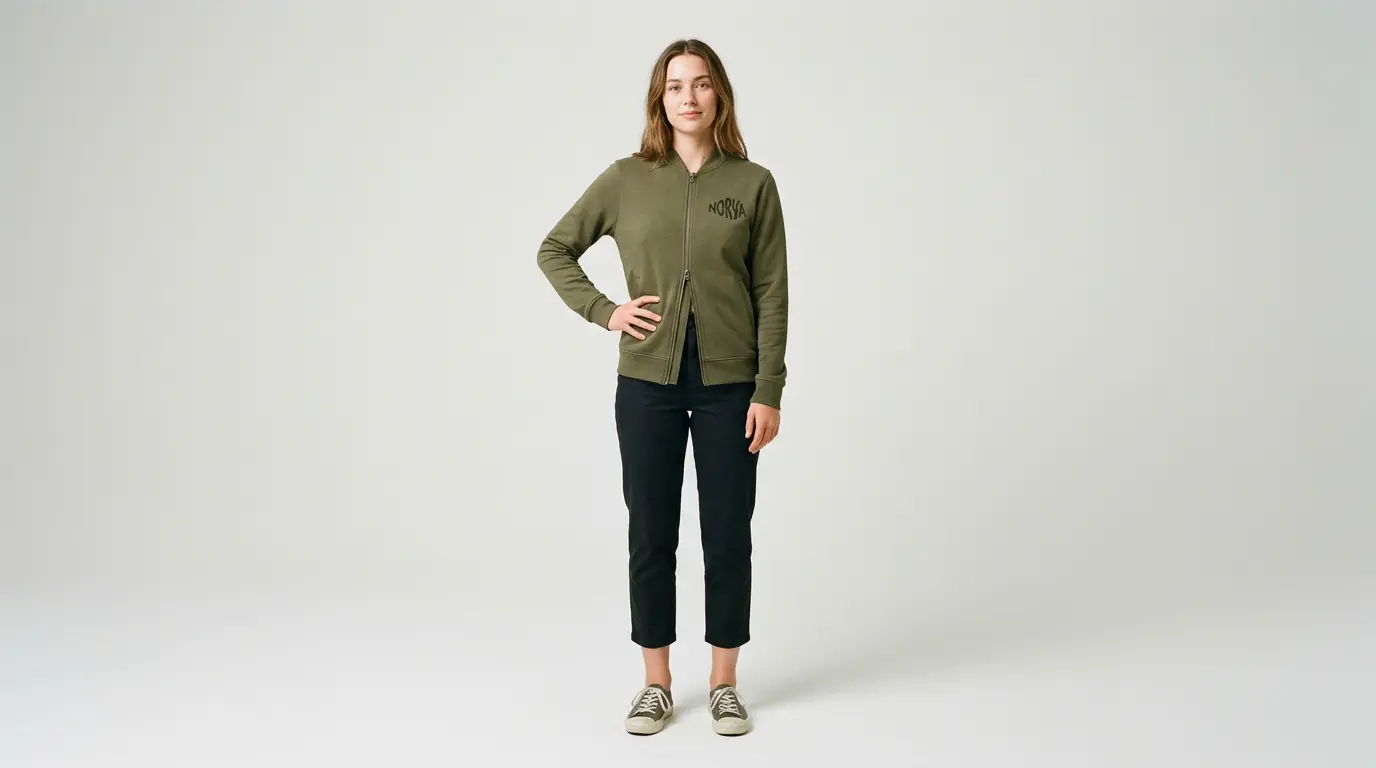
Illustrative example. A generated fashion image can look acceptable at a glance until the logo, zipper and hands are examined closely.
An AI-generated fashion image can pass at thumbnail size. Enlarge it and problems may appear: a hand with an extra joint, an ankle with no visible structure, a zipper that ends partway down the garment, a logo that dissolves into texture.
Spotting these problems is only the first step. The second is describing them in a way that tells a retoucher what "correct" means. A note like "fix the hand" or "zipper looks off" leaves that open, and different retouchers may close it differently. Revision rounds often start there.
This is the central point of AI fashion model retouching: the quality of a correction depends heavily on how clearly the defect is identified and described. The retouching comes second. This article covers how to tell kinds of defects apart, how to separate a real error from a legitimate design choice, and how to write instructions that leave less room for interpretation.
Four categories, and only three are defects
When a reviewer examines an AI-generated fashion image, they sort what they see into categories. The category shapes both the fix and the instruction. One rule applies to all four: judge against the approved design, the product reference and the brief, not against what looks familiar.
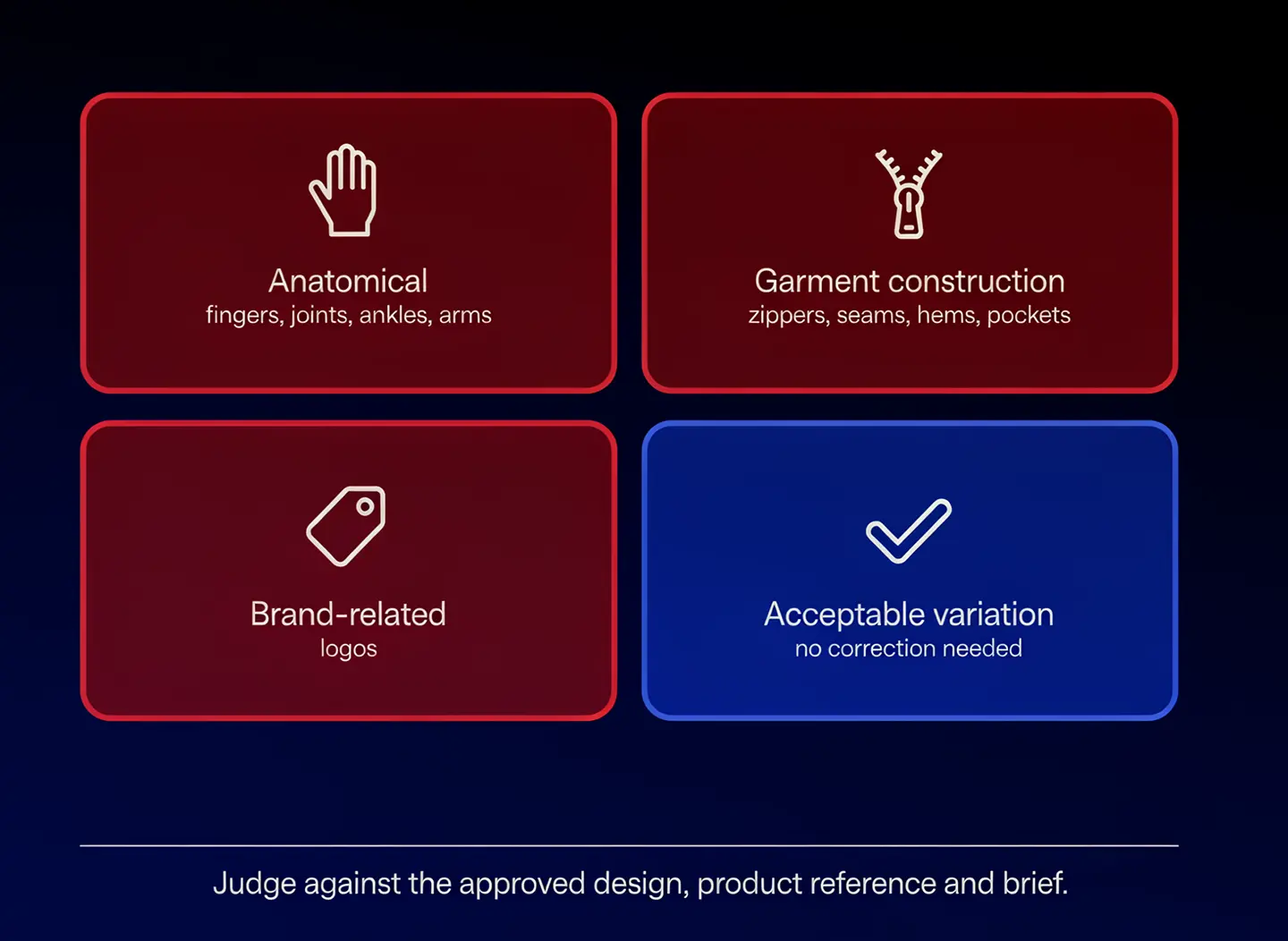
Illustrative diagram. Three kinds of defect and one kind of acceptable variation.
Anatomical inaccuracies
These tend to be the most noticeable, and they cluster where generation is hardest: fingers and nails, joints, ankles, and the position of arms and hands.
A useful test is whether the body could physically hold this position. A hand with six fingers fails. So does an arm that bends where there is no elbow. Ankles are harder to catch, because nothing looks broken. The ankle may read as a smooth tube with no definition, and a viewer may sense something is off without being able to say what.
Even here, the brief matters. A model may have tattoos, scars, an unusual silhouette or an editorial pose that is deliberate. Those are design inputs. The reviewer is looking for forms that cannot be physically correct, not features that merely differ from a default.
Garment construction problems
Here the image shows a garment that could not be made or worn as depicted: a zipper that changes direction or stops partway, a seam that disappears, a hem that frays into the background, a pocket that appears on one side only.
The reviewer's question is whether a real version of this garment could look like this, and the answer depends on the product reference. An asymmetric zipper, a single pocket or an uneven hem may be exactly what the designer intended. The same visual feature is a defect in one brief and a design detail in another. Without the reference, a reviewer is guessing, and so is the retoucher.
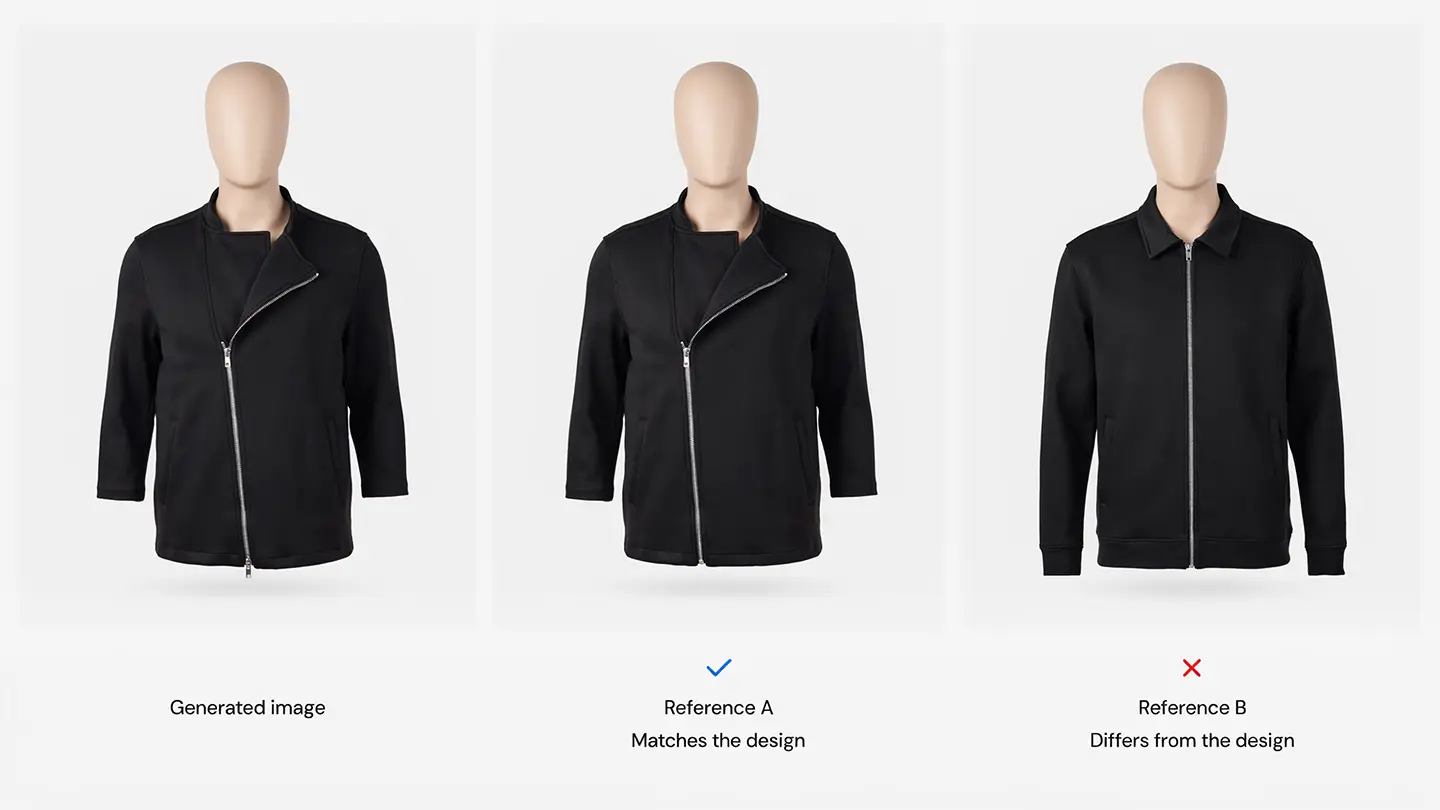
Illustrative example. The same generated image can be correct or defective depending on the approved design.
Brand-related defects
A distorted logo is a different kind of problem because the brand carries the risk. Warped letterforms or a wrong proportion may pass a casual look and still be unusable. The fix is often a replacement against an approved logo file, not a retouch, which is why the reference is essential.
Acceptable creative variation
This is the category teams most often skip. Not every difference from the brief is an error. Fabric can drape in ways you did not specify and still be perfectly plausible. A pose can differ slightly from the reference. Lighting can shift within the range of a believable studio setup.
Flagging these creates revision work with no gain. If the brief says nothing about a detail, it is usually a decision for the client, not an automatic defect.
The boundaries blur in practice, which is where consistency is easily lost. Two reviewers can look at the same unusual drape and disagree about whether it needs fixing. A shared reference is what settles it.
A five-part way to describe any defect
This is a framework you can adopt in your own briefs and review notes, whether you work with an in-house team or an outside retoucher. It answers five questions each time:
Location → Defect → Reference → Required correction → What must remain unchanged
- Location: where exactly in the image.
- Defect: what is wrong, in plain terms.
- Reference: what "correct" looks like, whether an approved image, a product photo, a logo file or a written rule.
- Required correction: the specific change.
- What must remain unchanged: the nearby elements that should not move.

Illustrative diagram. A five-part way to describe any AI image defect.
The last part is often missing. A retoucher fixing a hand may smooth the cuff beside it or shift the garment edge. Nobody asked for that, and nobody said not to.
An illustrative example
The scenario below is hypothetical and was written to demonstrate the framework. It is not a Studio Metrodesk client project.
Imagine a generated image of a model in a zip-front jacket. The zipper runs down the chest, but about halfway it splits into two parallel tracks and ends without a pull.
A vague instruction: "Fix the zipper."
A retoucher reading this has open questions. Should the zipper be closed or partly open? Is it meant to sit at the center or off to one side? Which track is correct? Where does it end? Is a pull needed, and what does it look like? Different retouchers could reasonably produce different jackets, each of them "fixed."
A specific instruction:
- Location: Center front of the jacket, from the collar to the hem. The split begins at about chest level.
- Defect: The zipper divides into two parallel tracks and has no pull at its end.
- Reference: The approved product photo, which shows a single metal track, centered, with a matte silver pull at the collar.
- Required correction: Rebuild the zipper as one continuous centered track, fully closed, with the pull at the collar.
- Must remain unchanged: The jacket's fabric texture, the collar shape, the model's pose and the background.
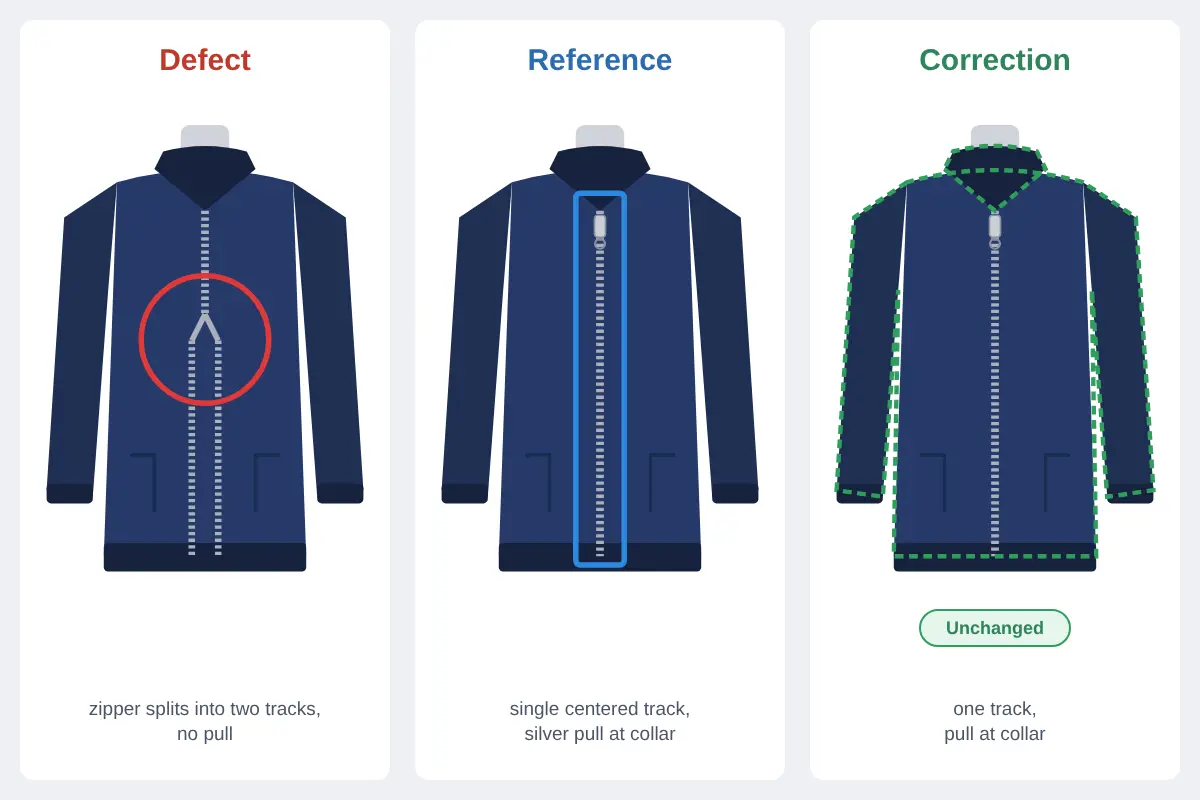
Illustrative example, not a client project and not a real correction. A split zipper, the approved reference, and a correction that leaves everything else unchanged.
Notice what the reference is doing. If the approved design had an off-center or asymmetric zipper, the same visual would call for a different instruction, or none at all. The written description also gives a reviewer something to check the finished image against.
Why clearer instructions matter commercially
None of this guarantees an outcome. A precise instruction cannot make a poor source image perfect, and complex corrections may still need adjustment. But the logic is straightforward:
- Fewer unnecessary revisions are likely. An instruction that can be read in one way is more likely to be applied as intended the first time.
- Batches are easier to keep consistent. The same written description applied across many images leaves less to individual judgment.
- Less ambiguity between you and the retoucher. Many disagreements trace back to unstated assumptions, and the five parts make assumptions visible.
- Closer adherence to approved references. A named reference is something the work can be checked against.
- More predictable scheduling. Fewer revision loops make delivery dates easier to plan.
These are expected benefits of reducing ambiguity, not measured results. They are also the reason the identification step deserves as much attention as the retouching, and it is the basis of sound AI image quality control.
When the same problem keeps appearing
Some defects will recur, depending on the generation tool, the prompts and the product. A recurring problem is a signal to review, not an automatic new rule.
A sensible path is to document the recurring issue, propose how it should be handled, and get that approved before it enters your guidelines. For anything that affects how the brand looks, approval belongs with the brand owner. Once approved, the decision can be recorded in the style guide, presets and checklists so it does not have to be re-explained. A genuine one-off is better logged as an exception, so it does not harden into policy.
How Studio Metrodesk approaches AI-generated image correction
We correct AI-generated fashion model imagery for generative-AI startups and agencies. The AI fashion model retouching page lists finger adjustments and nail work, tongue corrections, bone refinement, garment enhancements, object adjustments, zipper detailing, shoe corrections and logo replacement. For garment-focused work, the related apparel retouching service covers fabric cleanup, shape correction, symmetry and color consistency.
Calibration comes first. On any project, we start from the client's style guide, brand assets and sample images and turn them into production rules. We then edit a small calibration set, usually three to five images, and send it for feedback. If the client has comments, we revise the samples, and the client signs off on the style before volume begins. From calibration to sign-off, most projects take two or three rounds. Simpler ones can settle in one or two. This is where "what counts as wrong" is agreed in practice, before volume depends on it.
Unclear cases are escalated. When an image does not fit the rules, the editor flags it with a comment and, where useful, a screenshot or reference. The purpose is to put the decision with someone who has the authority to make it. We consult the client when no rule exists, when the decision affects brand look or legal safety, or when there is no reference showing the intended result. We describe this process in more detail in A Style Guide Can't Cover Every Fashion Image. Here's What Happens Next.
Three QC stages. Every order passes three checks before delivery. The first covers general retouching quality, masking, color, symmetry, and shadows and reflections. The second looks at consistency across images, brand compliance, missed instructions and edge cases. The third checks delivery specifications, client requirements, metadata, naming and format. For generated fashion imagery, the first stage is where problems in an individual image are caught, the second is where a set is compared for drift such as a garment detail changing between frames, and the third confirms the files arrive as specified. We do not rank the stages; they check different things.
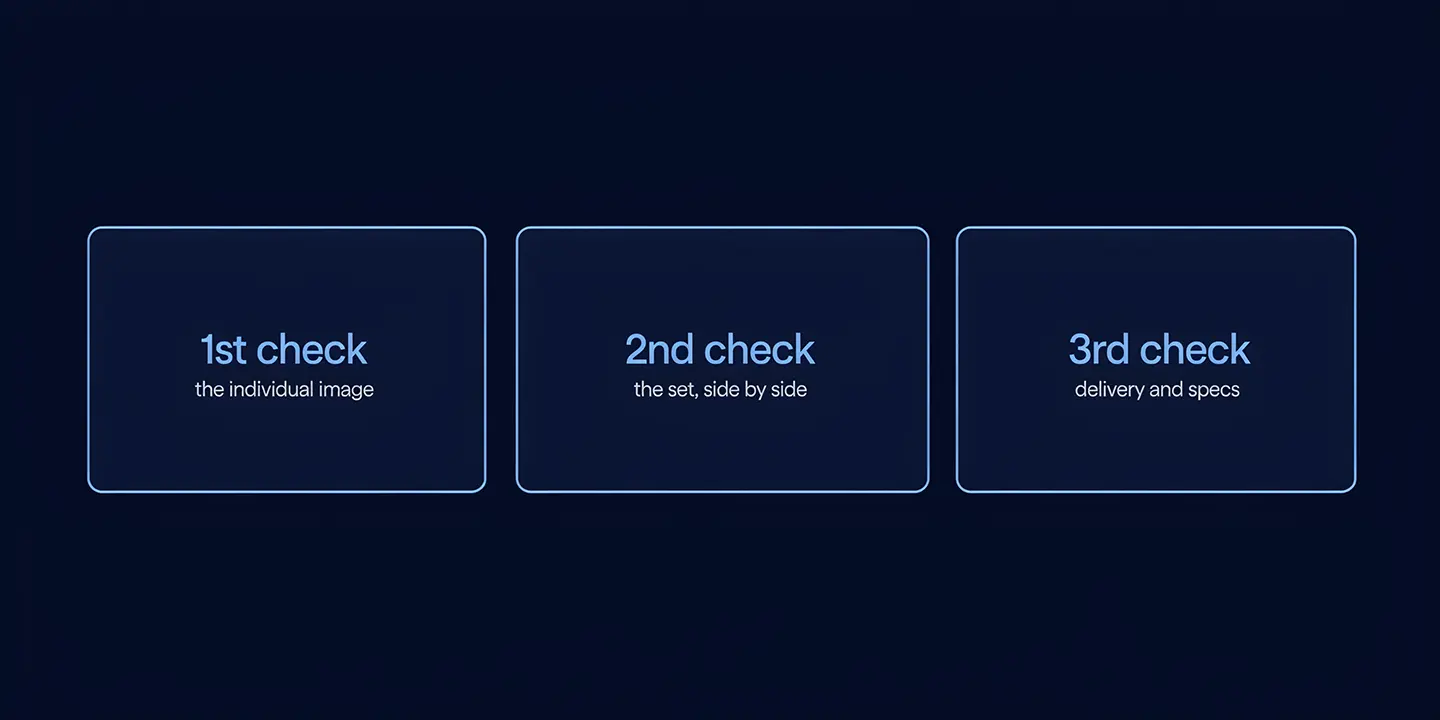
Illustrative diagram. The three QC stages check different things before delivery.
Continuity is optional. If you produce imagery continuously, Build Your Team offers a dedicated retoucher or team with a communication specialist and daily progress reports. It is a separate arrangement, not part of every order.
The AI retouching page lists 12 to 24 hours as the usual turnaround, depending on image quantity and complexity. Orders above 3,000 images are scheduled by discussion. Other turnaround options are published separately.
What to bring to a correction project
Whoever does your retouching, four inputs help:
- A reference for "correct," such as the approved design, product photo or logo file.
- The defects you see most often, so reviewers know where to look closely.
- Your tolerance, meaning which differences count as errors and which are acceptable.
- A named decision-maker for cases where a correction would change the brand's look.
Try it on your most difficult images
If you have AI-generated fashion images that need correction, send up to three samples with your references and notes on what matters most. Instructions written in the five-part format above work well for this. We will edit them free of charge so you can see how your references are applied to the difficult details.
Trial eligibility is tied to project size, so please mention your expected volume when you submit. If you would rather talk first, you can request a quote or contact the team and speak with Lutfor Rahman Peri, Vice President of Sales and Communication, or our support staff.
Abdul Hashib Bipu
01 Nov 2026
From the blog
The latest industry news, interviews, technologies, and resources.

Abdul Hashib Bipu • 23 Nov 2026 • 7 min read
Rush Is a Planning Decision, Not a Quality Setting
A short deadline doesn't lower retouching quality. Undecided style does. How to choose a turnaround from 1 hour to 7 days, and what to settle before you place a rush order.
Post Production Company

Abdul Hashib Bipu • 23 Nov 2026 • 7 min read
The Retoucher Who Already Knows Your Look: How Our Dedicated Team Model Works for Fashion Brands
A fashion brand hiring one designer to carry retouching and consistency is betting on one person's memory. Here is how a dedicated retoucher, a communication expert and daily reports turn that into a system.
Outsourcing Company
Post Production Company

Abdul Hashib Bipu • 23 Nov 2026 • 11 min read
Your Photo, Your Render and Your AI Image Should All Show the Same Product
A housewares brand's brief asked for one thing: make sure the photo, the render and the AI image all show the same product. Here's how we keep three different image sources matched to one approved color standard.
Post Production Company
Product Photo Retouching

Abdul Hashib Bipu • 23 Nov 2026 • 14 min read
The File That Leaves Us Has to Be the File That Goes to Press
How Studio Metrodesk keeps high-volume catalog, packaging and collectible images color-accurate and error-free before handing them off for print.
Post Production Company

Abdul Hashib Bipu • 23 Nov 2026 • 8 min read
The Sample Always Looks Great. The Question Is What Happens at Your Real Volume.
A sample round proves quality, not capacity. Here's the turnaround structure to check, and four questions to ask, before a seasonal volume spike.
Post Production Company

Abdul Hashib Bipu • 10 Nov 2026 • 8 min read
Your Brand's Look Shouldn't Depend on Who Edits the Image
What we do in the first week with a new client so the hundredth image matches the first: calibration rounds, saved preferences, three QC checks and a clear path for exceptions.
Post Production Company
Hey! As you have come this far, why don't you take a chance on us?
Try Us for Free